
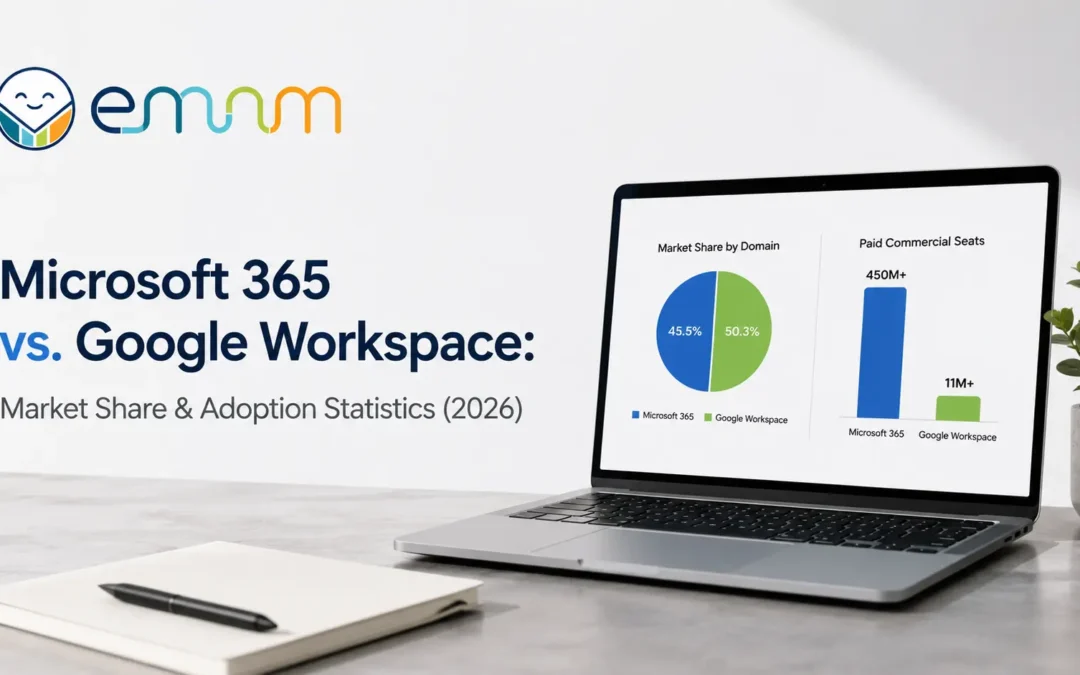
Quick answer: There is no single “market share” number for Microsoft 365 vs. Google Workspace. The correct figure depends entirely on whether you measure by domains, paid seats, enterprise revenue, or email opens. This page lays out every major methodology side by side, sourced directly from Microsoft and Alphabet’s own investor disclosures wherever possible.
If your business is choosing a platform, or your IT team is deciding whether to migrate, the “who’s winning” headlines rarely tell the whole story. A vendor claiming “50% market share” and a vendor claiming “58% market share” can both be telling the truth, because they’re measuring completely different things. This page collects the underlying numbers so you can see exactly what each stat is counting.
Want to see more content like this? Add us as a Preferred Source on Google to see more of our articles when you search.
Market Share: It Depends How You Count
There are four common ways analysts measure the Microsoft 365 vs. Google Workspace race, and each produces a different leader.
| Measurement Method | Microsoft 365 | Google Workspace | What It Actually Measures |
|---|---|---|---|
| Total domains (all business sizes) | 45.46% | 50.34% | Every registered domain using either platform’s mail servers, weighted heavily toward small and micro businesses |
| Enterprise segment only | ~58% | ~42% | Large-organization deployments, where Microsoft’s desktop-app and compliance ecosystem dominates |
| Paid commercial seats | 450M+ (Microsoft, self-reported) | 11M+ paying customers (Google, self-reported) | Note: Microsoft counts individual licensed users; Google counts paying organizational accounts, so these figures are not directly comparable |
| Fortune 500 primary platform | ~75% | ~25% (estimated) | Which suite a large public company uses as its default productivity platform |
The takeaway for business owners: if you’re a small or mid-sized business, you’re statistically more likely to already be on Google Workspace or considering it. If you’re evaluating what your enterprise peers use, Microsoft 365 pulls well ahead.
Microsoft 365: The Numbers Behind the Seats
Microsoft reports its Microsoft 365 commercial numbers every quarter, which makes this one of the more reliable data trails in the industry.
- Microsoft 365 commercial paid seats grew 6% year over year to more than 450 million, according to Microsoft’s fiscal Q2 2026 investor results.
- Microsoft 365 Commercial cloud services revenue increased 17%, driven by growth in revenue per user from Microsoft 365 E5 and Microsoft 365 Copilot adoption, per the same Microsoft FY26 Q2 productivity segment report.
- Seat growth is concentrated in small and medium business and frontline worker offerings rather than large enterprise, a signal that Microsoft’s SMB push is actively converting new accounts, based on commentary from the Microsoft FY26 Q2 earnings conference call.
- Large-scale enterprise commitment is accelerating: the number of customers purchasing more than 35,000 Microsoft 365 seats tripled year over year, with organizations like Fiserv, ING, NASA, and Westpac among the new large deployments, as detailed in the Microsoft FY26 Q2 earnings call transcript.
- On the AI side, Microsoft 365 Copilot reached 20 million paid seats by its fiscal Q3 2026 earnings call, up from 15 million the prior quarter, a 33% jump in a single quarter, reported by No Jitter’s coverage of the Copilot seat milestone.
- Even with that growth, Copilot penetration remains modest: only about 4.4% of Microsoft’s roughly 450 million commercial Microsoft 365 seats carry a paid Copilot add-on, leaving the vast majority of the installed base unconverted, per this 2026 Copilot adoption data roundup.
Google Workspace: The Numbers Behind the Seats
Google discloses Workspace figures less granularly than Microsoft, but the available data points to a platform anchored in reach rather than per-seat revenue concentration.
- Google Workspace serves more than 3 billion users globally and over 11 million paying customers across enterprise, business, and education segments, according to this 2026 Google Workspace statistics compilation drawing on Alphabet’s disclosures.
- Alphabet’s Q4 2025 earnings reported double-digit Workspace growth, driven by an increase in both average revenue per seat and total seat count, per the same Google Workspace 2026 statistics report.
- On the AI side, Gemini Enterprise sold more than 8 million paid seats across 2,800 companies within its first four months on the market, a fast ramp for a brand-new commercial product, as noted in that Google Workspace statistics summary.
- Google’s broader Gemini platform crossed 950 million monthly active users as of Alphabet’s most recent quarterly report, up from 750 million at the close of 2025, giving Workspace a large installed AI-user base to convert into paid seats, according to Forbes’ coverage of Alphabet’s Q2 2026 earnings.
- Nearly 90% of the Fortune 100 now use Gemini Enterprise in some capacity, according to Sundar Pichai’s remarks on Alphabet’s Q2 2026 earnings call, though this figure includes pilots and partial rollouts alongside full deployments.
Gmail vs. Outlook: Business Email Adoption
Market share for the underlying suites is one thing; adoption of the actual email client is another, and the picture shifts again depending on company size.
| Metric | Gmail | Outlook |
|---|---|---|
| Companies using it globally (adoption count) | ~3.9 million | ~3.6 million |
| Email management category share | ~23.5% | ~19.9% (bundled M365) / ~13.8% (Outlook client alone) |
| US startup adoption | 90%+ | Lower, grows with company age |
| US mid-sized company adoption | 60%+ | Higher, grows with company size |
| Enterprise / regulated industry lean | Lower | Higher, especially finance, legal, healthcare, public sector |
The pattern is consistent across every data source we reviewed: Gmail leads in overall business adoption with close to 3.9 million companies, edging out Outlook’s roughly 3.6 million, but the split reverses sharply by company type, according to this 2026 Outlook vs. Gmail business comparison. Outlook holds a disproportionate share among larger organizations, particularly in finance, legal, healthcare, and the public sector, where Microsoft infrastructure is already the standard, per the same Gmail vs. Outlook adoption breakdown. Meanwhile, over 90% of US startups and more than 60% of US mid-sized companies run on Gmail, reflecting its pull with leaner, cloud-first teams, as that business email adoption comparison notes.
For a business owner reading this, the practical signal is simple: your industry and your existing IT stack matter more than any single “who’s bigger” headline. A law firm or medical practice is swimming with the current on Microsoft 365. A ten-person marketing agency is swimming with the current on Google Workspace.
Why Businesses Switch Platforms
Migration activity between the two platforms runs in both directions, and it’s picking up rather than slowing down.
- Google is actively marketing against Microsoft on migration friction: at its 2026 enterprise conference, Google announced that migration speeds for organizations moving from Microsoft 365 to Google Workspace, including complex finance departments, have increased by up to five times, as reported by BigGo Finance’s coverage of Google Cloud Next 2026.
- On the Microsoft side, the pull is coming from ecosystem consolidation rather than dissatisfaction. Analysts describe a growing wave of Google Workspace to Microsoft 365 migrations driven by practical ecosystem consolidation rather than unhappiness with Google’s platform, per this 2026 email platform migration analysis.
- Switching costs are real and worth budgeting for. Full-scale platform transitions for larger organizations can involve user retraining, legacy-file migration, and integration reconfiguration that push total switching costs for a 1,000-user organization into the $500,000 to $1.5 million range, according to this 2026 Microsoft 365 vs. Google Workspace business comparison; costs scale down significantly for smaller teams but are rarely zero.
- Roughly 64% of organizations now run both platforms simultaneously in a dual-stack environment, typically using Microsoft for email and document management and Google for lightweight collaboration in specific teams, rather than treating the decision as strictly either-or, per this platform comparison covering dual-stack adoption.
That last point is one that gets missed in most head-to-head comparisons: for a meaningful share of mid-market and enterprise organizations, the real-world answer isn’t “Microsoft or Google,” it’s “Microsoft and Google,” managed side by side.
Key Takeaways
- By raw domain count, Google Workspace edges out Microsoft 365. By enterprise seats and Fortune 500 adoption, Microsoft 365 leads by a wide margin.
- Gmail wins on total business adoption; Outlook wins on enterprise and regulated-industry adoption. Company size and industry predict your likely current platform better than any overall market share figure.
- AI is now a genuine differentiator in seat growth for both platforms. Microsoft 365 Copilot and Gemini Enterprise are each converting existing seats into higher-revenue AI-enabled seats, though penetration for both remains under 5% of the eligible installed base.
- Migration in both directions is accelerating, not slowing down, and a majority of larger organizations are quietly running both platforms rather than picking one.
If your organization is weighing a move in either direction, our Microsoft 365 vs. Google Workspace: Which Is Right for Your Business in 2026? guide walks through the decision framework, and our platform-specific migration guides cover the technical steps for Google Workspace to Microsoft 365 and Microsoft 365 to Google Workspace moves.
Frequently Asked Questions
Does Microsoft 365 or Google Workspace have more market share in 2026? It depends on the measurement. By total domains, Google Workspace holds a slight lead at just over 50% versus Microsoft 365’s roughly 45%. By enterprise seats and revenue, Microsoft 365 leads by a wide margin, holding an estimated 58% of the enterprise segment and roughly 75% of Fortune 500 companies as their primary platform.
How many companies use Google Workspace vs. Microsoft 365? Google reports more than 11 million paying Workspace customers across enterprise, business, and education segments. Microsoft reports more than 450 million paid Microsoft 365 commercial seats, though this counts individual licensed users rather than organizational accounts, so the two figures aren’t directly comparable.
Is Gmail or Outlook more popular for business email? Gmail has a slight edge in overall company adoption, used by an estimated 3.9 million businesses worldwide compared to roughly 3.6 million for Outlook. However, Outlook adoption climbs sharply with company size and is especially common in finance, legal, healthcare, and public sector organizations.
Are businesses migrating from Google Workspace to Microsoft 365, or the other way around? Both. Migration activity runs in both directions in 2026, with Microsoft 365 gaining share largely through ecosystem consolidation among growing businesses, and Google Workspace winning migrations by marketing faster, lower-friction switching tools. A significant share of mid-market and enterprise organizations run both platforms at once rather than standardizing on a single suite.
How many organizations use both Microsoft 365 and Google Workspace at the same time? An estimated 64% of organizations run a dual-stack environment, using both platforms simultaneously, typically Microsoft 365 for email and document management and Google Workspace for lightweight collaboration in specific teams or departments.
Need expert help? EMNMS is here to help with all your email management needs!
Recent Comments